
The War Seal Foundation
The Stoll Foundation – founded in 1916 as the War Seal Foundation – has a rich history spanning over 100 years.
Idea and Foundation
As a boy, Oswald Stoll was deeply moved by a performance of the song “Here upon guard am I” by Charles Godfrey, which showed the neglect of Crimean War veterans returning to England, and featured the lines “I’ve done this for my Country / But what has she done for me.” Later, Oswald would refer to the song as well as witnessing injured Boer War veterans returning home as his main inspirations for founding The War Seal Foundation.
In 1914, at the beginning of the First World War, severely injured and traumatised men began returning to the UK. Over the course of the First World War over 2 million soldiers came back with a disability, including over 40,000 amputees. Others suffered from shell shock, blindness and deafness, lung damage from gas, tuberculosis and facial disfigurement and needed an extreme level of round the clock care. Veterans whose injuries allowed them to work had limited access to housing, jobs and accessible transportation to get there, and those who couldn’t work faced even worse circumstances as unemployment benefits were often rejected even for those were officially deemed “unemployable”
Using his standing and contacts, Sir Oswald set about establishing the War Seal Foundation, which planned to provide injured veterans and their families with a place to call home and vital support. It was unique amongst other veterans’ housing schemes as it allowed families to live together and offered holistic support including medical treatments and social activities delivered on site.
“It shall be distinctly understood that this is not a charitable matter. The disabled men and their dependants will have fully earned the benefits which it is hoped to give them. Above all, the fact of a man being there will be to his honour. It will be a distinctive mark of his great self sacrifice in the national cause. He will be the man who dared and did for his country.” – Oswald Stoll, 1915
War Seals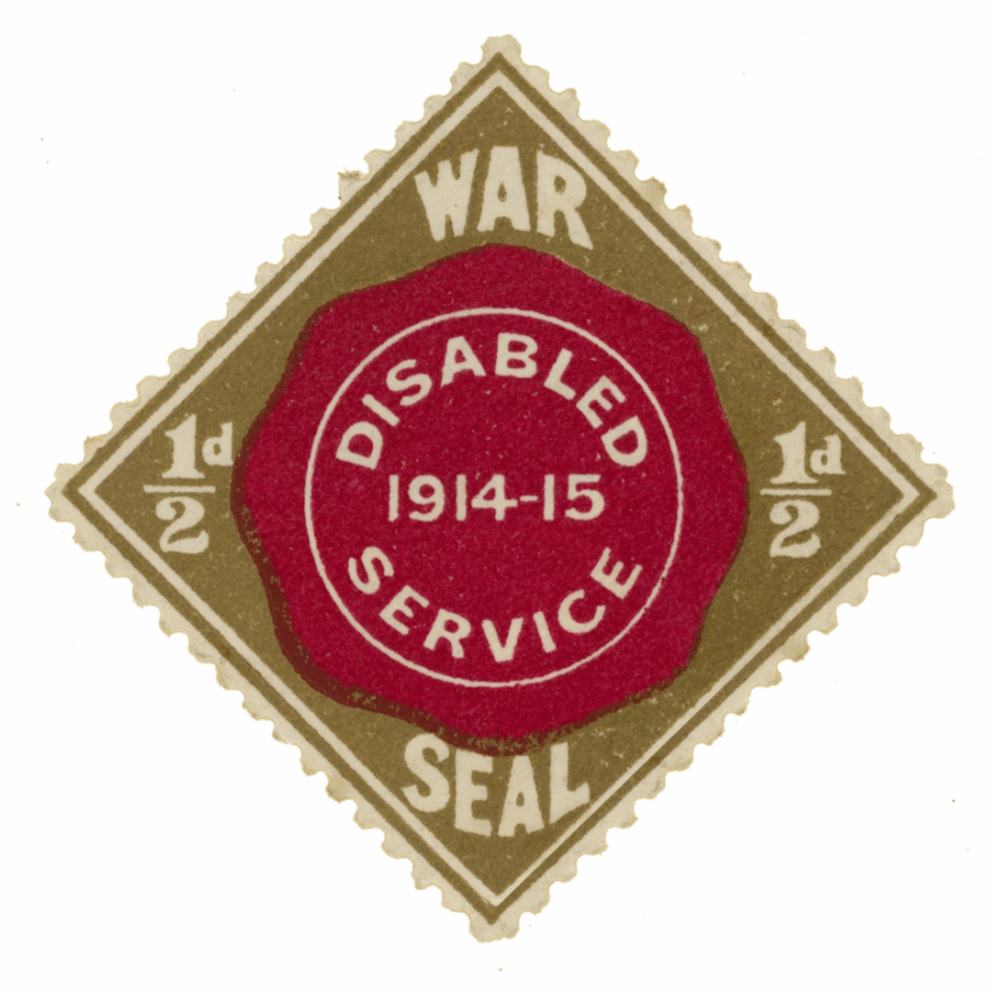
To fund The War Seal Foundation and turn the proposed homes into a reality, Sir Oswald came up with the idea of the ‘War Seal’ from which the charity eventually took its name. He commissioned millions of small diamond shaped red and gold stamps which read ‘War Seal – Disabled Service 1914-1915’. These were sold in shops (including Harrods) and train stations across the country for half a penny each, generating millions of pounds in donations. Individuals and companies could apply for a certificate that gave them permission to sell War Seals themselves to raise money for The War Seal Foundation, much like shops and individuals are able to sell Poppies today in aid of the Royal British Legion. They were also sold in Sir Oswald’s theatres, and in the businesses of two of his associates, who would eventually become trustees of The War Seal Foundation: Harry Gordon Selfridge of Selfridges Department Store and Jesse Boot of Boots Pharmacies. In total, over 22 million War Seals were told.
Building War Seal Mansions
Sir Oswald had originally planned to build a theatre in Fulham, in the shadow of Stamford Bridge. After planning permission was denied, Oswald instead donated the land to become the site of The War Seal Foundation’s first property. War Seal Mansions was constructed between 1917 and 1923, first with 48 flats and then expanded to contain 138 flats in total. The site included a community hall, medical wing, on-site grocery store, landscaped gardens and dramatic rose pergola covering the entrance. The gates featured the names of famous WWI battles and were topped with large gas lamps, while other plaques paid tribute to the residents and the original supporters of the organisation. A golden mosaic War Seal sat (and still sits) on top of the ornate front of the building. The total cost of building the Mansion was around £56,000, which would be equivalent to £3.4 million today.
Life at War Seal Mansions
Residents were chosen by a committee mostly made up of medical professionals, who ensured that only men who would benefit the most from the Foundation’s support were admitted. The first residents of the Mansions were severely (or “totally” as they were referred to at the time) disabled, including double amputees and those who were completely paralyzed. The first veterans to be admitted was James Pegrum who was shot and had both legs paralysed at the Somme. Residents received round the clock care from an onsite medical team, who delivered around 15,000 treatments per year, including artificial sunlight, exercises, massage and electrical treatments. Boots the Chemist provided free medicine to residents until the 1940s.
Initial rent was 6s 6d (£16 today) per week. This was far below the average rent in London which was about £2 per week, and was affordable to a veteran classed as “totally disabled” who received a military pension of just 25s per week (or higher for officers). Tenants were also able to take up paid work in the onsite workshop, as well as at the Lord Roberts Memorial Workshop just across the road and the Poppy Factory in Richmond.
Women in the Mansions
All accepted applicants had to be accompanied by a woman; mostly a wife but occasionally a mother, who would provide the vast majority of the medical, child and house care that was needed. This was constant, gruelling work, and as a result many wives died before their severely injured and ill husbands from the strain.
“The care of a badly disabled man required tremendous stamina. Women not only nursed their disabled husbands and took exclusive responsibility for housework and children but also, if the family budget required, went out to work. Before she and her husband moved to the War Seal Mansions, Mrs. Ripley held down a job, cared for the couple’s young daughter, and carried her wheelchair-bound spouse up two steep flights of stairs every day—on her back. The women suffer almost as much as the men.” – W.J. Roberts, War Seal Foundation Secretary
In the early days of the Foundation, when their husbands died, the widows and their children were swiftly removed from the Mansions and left to find alternative housing and fend for themselves so that the flats could be filled with other disabled veterans from the Foundation’s waiting list. Today, The Stoll Foundation allows widows to remain in their homes and provides them with the same support their deceased partners received.
Second World War
When news that the Second World War had broken out reached the veterans at the Mansions, there was significant distress. Advice on what to do in case of an attack and gas masks were handed out, and residents were asked to sign a document stating whether or not they wished to be evacuated or left in their flat in the event of air raids. The Foundation attempted to dig underground bomb shelters in the garden, but were unable to due to the make up on the ground, and instead had to settle for a “cold, joyless” above ground shelter which was hastily build on the property.
The local authority did not include the severely injured and completely paralysed residents of the Mansions in their list of those who should be evacuated, which did include other disabled and blind local residents. As a result, the Foundation could not receive support from the council or government to evacuate the men, and were left to fend for themselves. Sir Stoll toured several country houses to find one he could purchase to evacuate the most vulnerable residents, but the problem of transport remained, and the government and council would not offer any help. The concept of evacuation was entirely abandoned by 1942 and sandbags were instead used to defend the Mansions as best as possible.
The Mansions suffered bomb damage that could not be repaired until several years after the end of the war due to financial difficulties, but there are luckily no reports that anyone was killed or severely injured. The air raid shelter was demolished in 1947.
Present Day
In 1937 the charity was renamed to The Sir Oswald Stoll Foundation in honour of its founder, and the Mansions were renamed Sir Oswald Stoll Mansions. The charity was later renamed to just Stoll, and in 2025 was given its current name: The Stoll Foundation. The charity now operates several other schemes around West London and Aldershot in addition to the Mansions, including Centenary Lodge in Aldershot, Chiswick War Memorial Homes, Countess of Wessex House in Feltham and Banstead Court in East Acton.
The Mansions and the Foundation have undergone many changes since 1916. The property has been continuingly modernised, with Wireless installed in every flat in 1925, electricity brought to every flat in 1947, a garage for motor chairs and cars, new lifts and laundry machines in the 1950s, and extensive improvements made in the 1970s. However, the Sir Oswald Stoll Mansions is an old building, constructed using charity funds at a time of post-war shortages and austerity. By the 21st century, the building required significant repair work to remain habitable, work which was set to cost around £10 million.
As a result, The Stoll Foundation made the difficult decision in 2024 to sell the Mansions and move our residents to nearby, much higher quality and sustainable accomodation. The Mansions were sold to our neighbour, Chelsea FC, while two new buildings were purchased for veterans in the luxury King’s Road Park development, just 10 minutes walk away. The Stoll Foundation maintains access to the Mansions until mid 2027 and a number of flats for veterans still remain on the site.
After Sir Oswald Stoll’s death, his wife succeeded him as President, and his sons remained involved in the charity. The last Stoll on the charity’s board was Sir Oswald’s son Dennis, who died in 1987.
Learn more:
Sir Oswald Stoll
Learn about our founder, theatre impresario and philanthropist Sir Oswald Stoll, the “father of the music hall”.
Theatre and Film Empire
Find out more about Sir Stoll’s vast network of theatres, his many innovations and his role in the film industry.
Veterans’ Voices
Explore our heritage project, made possible thanks to the National Lottery Heritage Fund and find out how you can get involved.